Peak season does not wait for you to catch up.
Most distributors treat summer as a busier version of the normal year, the same routes and the same accounts, just more of it. But in beverage, summer is not more of the year. It is a large share of the whole year, packed into a few weekends where the margin is real and the room for error is almost none.
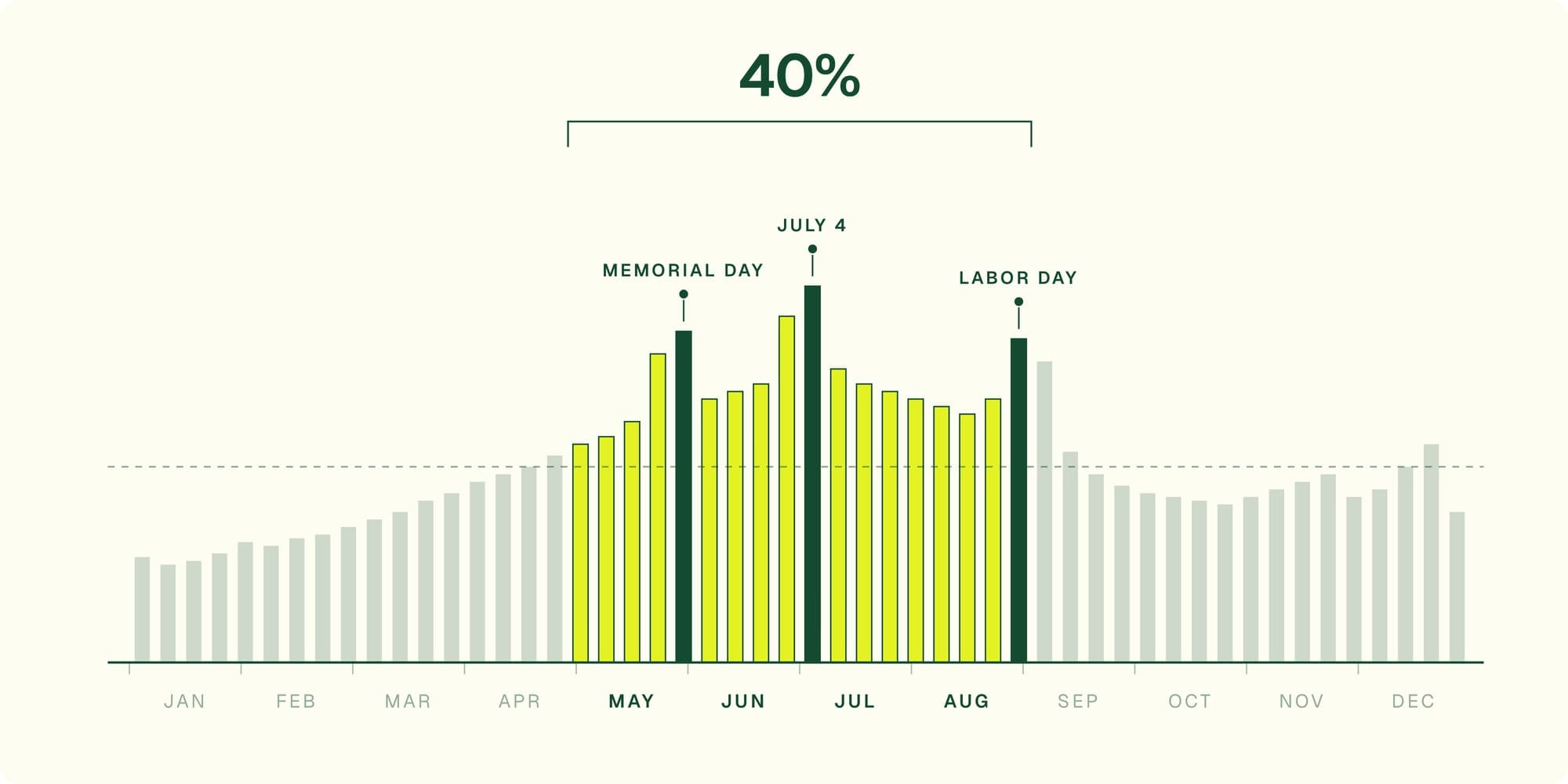
May through August account for roughly 40% of the beer sold in a given year, according to National Beer Wholesalers Association data, and the calendar bunches the biggest days into a handful of holiday weekends. The Fourth of July is the single biggest beer-selling holiday in the country, with Memorial Day second and Labor Day third. Get those weekends right and the season carries the year. Miss them, even by a little, and the cost compounds in places that never show up on one line item.
This blog walks through how concentrated summer volume really is, what one out-of-stock actually costs across the operation, why spreadsheet and swivel-chair systems make it worse, and what peak season looks like when order entry, inventory, and execution run on one connected platform.
Why summer is the whole ballgame
The numbers around the Fourth show how concentrated it gets. In the weeks around the Fourth and Labor Day, beer deliveries to retailers run about 50% above the annualized weekly average. In 2025, 71% of Americans said they planned to buy beer for the holiday, and Independence Day shoppers spent an estimated $2.1 billion on beer, cider, and flavored malt beverages. The Beer Institute has found that three in four Americans reach for beer to celebrate.
The Brewers Association estimates a brewery moves close to 5% of its entire annual volume in the two weeks around the Fourth, with sales up roughly 25% the week itself. For the distributor in the middle, that means a meaningful slice of the year’s margin is riding on a few Saturdays, delivered by a team that is already stretched thin. The upside is huge, and so is the downside, because demand peaks across every account at the same time.
What a single out-of-stock actually costs
Consider one hot Saturday before the Fourth. A featured 12-pack is out in three of your chain accounts by noon. The displays you helped build sit half empty, shoppers grab whatever is cold and next to it, and the supplier’s brand manager sees the gap in the numbers the following week. One out-of-stock, a half-dozen costs, none of which land on a single line item.
Now multiply that across the operation.
- Lost cooler sales. Industry estimates put beverage stockouts at roughly 8% of daily sales lost. On the highest-volume days of the year, that is your best revenue walking out the door.
- Brand switching. Close to 70% of the time, a shopper who finds an empty shelf either buys nothing or switches brands on the spot. The sale you lose today can cost you the loyalty behind it.
- Promotional blowouts. Promotional items, the displays and features you spend co-op dollars to drive, run out of stock at roughly twice the rate of everyday items, so the exact products you are paying to push are the ones most likely to go dark.
- Warm product and spoilage. In the cooler specifically, beverage teams lose an estimated 7% of sales on top of stockouts to warm product and temperature swings. Execution is physical, not just a number in a system.
- Retailer and supplier trust. The account that runs dry through the Fourth is the account that rethinks your next reset, and the supplier who sees the miss is the one who reconsiders your allocation and marketing support.
None of these are visible on a single report. They live in eroded margin, lost authorizations, and the quiet decay of a supplier relationship.
Why manual systems break in peak season
Most distributors are still running peak season on some mix of a legacy route accounting system, a stack of spreadsheets, and the institutional knowledge of a few long-tenured people. That holds together in a normal week. It buckles when volume runs 50% hot.
The problem is not the effort. It is the lag. If your reps still re-key orders into two or three systems, every order is a chance for a typo, a duplicate, or a delay, and in peak weeks that tax compounds across every route. If your inventory picture is a snapshot from this morning, your team is promising product it may not have and sitting on product that is about to turn. If your shelf checks live on a clipboard, you find out about the out-of-stock after the weekend it cost you.
Every one of those gaps is a decision made on data that was already out of date. In July, out-of-date is expensive.
What peak season looks like on one connected platform
Handling the summer well is not magic, and it is not more headcount. It is removing the lag between what is happening in the market and what your systems know. Three things decide it.
Order entry comes first, because it happens the most. When order entry, live inventory, and account history sit on one screen, a rep places the order once, sees what is actually available, and moves to the next stop. Multiplied across a July running 50% above normal, that is the difference between a team that keeps up and one that falls a day behind and never recovers before Labor Day.
Inventory visibility comes next. When your team can see real stock positions in real time, across the warehouse and in transit, they stop overpromising and stop sitting on product that is about to code out. In a category where a hot brand sells through in a weekend, that visibility protects margin in the exact weeks you are moving the most cases.
On-shelf availability is where the money actually is. A distributor who can see which accounts are running low before the account calls, and route a rep to refill before the shelf goes bare, keeps the sale, the retailer, and the supplier all at once. This is how Ohanafy approaches peak season, not as a set of separate tools, but as one operating system where orders, inventory, and retail execution are connected by default, so the shelf reflects reality instead of last Monday’s plan.
Where to start
Distributors who want a calmer, higher-selling summer do not need to rebuild everything in June. The first move is an honest assessment.
How many systems does a rep touch to place one order? When a chain resets a planogram or a supplier adds a promotion, how long before that shows up in what your team sees in the field? On your highest-volume Saturday, do you know which accounts are running low in time to do something about it, or only after the weekend is over?
If those answers feel uncomfortable, the cost is already being paid. It just is not labeled as an out-of-stock. The distributors moving on this now are not chasing a perfect summer. They are removing the lag, and the gap between them and everyone else widens every peak season.
Learn more about Ohanafy Retail Execution.